page loader

In April 1998 Willoughby City Council established the Griffin Reserves Advisory Committee and its members consist of residents of Castlecrag, the Councillors of our Ward and Council staff. Its functions are to review the current Plan of Management for the Griffin Reserves in Castlecrag as it relates to the ongoing implementation, development, work and management of these areas and to advise on aspects of the use, control management of Griffin Reserves for consideration by Council. Its duties include monitoring and advising Council on the health and condition of bushland in the reserves and encouraging the visitation, promotion and enhancement of the natural and built features of the Griffin Reserves.

Much work has in the Reserves and Islands has been overseen by this committee since 1998. The work has been done using bush regeneration contractors and in some reserves working with residents. It is funded by Council. The nature of the work is necessarily slow and it will be some years before Griffin’s entire system of inter-related Walkways and Reserves is again able to be used safely. Regeneration and planting in The Buttress Reserve, below The Tower Reserve, has been underway for some time, but last week the contractor arrived to start work and was horrified to discover that vandals had ripped out plants and slashed or destroyed trees. All her efforts to restore the natural vegetation of this reserve had been made null and void.

Griffin’s vision for Castlecrag was one in which the natural landscape, not the built form was the dominant feature. The Plan of Management seeks to re-establish this vision and it is a matter of deep disappointment that some would seek to destroy this. Let us hope that The Buttress, after further regeneration work, and as the other Reserves are demonstrating, will become the place of natural loveliness it was planned to be.

Elizabeth Lander

Castlecrag mourns Battlement resident of 56 years, Neville Milston. Some 120 friends celebrated his life on 25 July, addressed by colleagues from the North Shore Temple Emmanuel, The Jewish Ex-Servicemen’s Association and the Masonic Lodge of Tranquility.

Born 1920 in Leichhardt, then growing up in Coogee, Neville had to leave school at 14 during the Depression to help in his parents’ gifts business. In 1938 he enlisted in the Citizens Military Forces at 18 as Hitler entered Czechoslovakia and he joined the AIF in 1941, became a radio operator and was shipped out to Malaya. His 8th Division Signals were ordered to join a British military post, but all had to surrender, and were imprisoned in infamous Changi.

Neville then spent 42 months building the 450km Burma Railway, working from 5am to 6pm on starvation rations and dropping from 60kg to a life-threatening 40kg. More than one-third of his comrades died. Liberated in August 1945 he needed extensive rehabilitation before returning to civilian life, and was awarded the Efficiency Medal. [For recollections see www.ajn.com.au April 2007]

In 1949 he met Madge Grouse, a Jewish ex-servicewoman who had seen duty in New Guinea. They married and moved to Castlecrag in 1951 ready to start living life to the full for their next 50 years together. Their three children – Michael, Richard and Leah (and two foster children) – and “their” suburb absorbed them.
Helping build the Infants School, raising of funds for the Walter Burley Griffin Fountain, the Castlecrag Conservation Society and the annual Red Cross Appeal, working for Meals-On-Wheels and other charitable and community endeavours were all part of community involvement. And in 1981 Neville completed a Bachelor of Arts degree: “to get the education I missed out when I was young”, he said.

His three loves outside the family were the Australian Labor Party (he was awarded the McKell Award in 2003 for long and distinguished service), the Masonic Lodge, and Liberal Judaism. It appears that his continued active involvement in such community groups was an important ingredient in his physical and mental longevity…… perhaps a lesson for us all.

He was active to his last day, often seen at the local shops, never mentioning his own ill-health, and always a kind word and empathy for others’ concerns. He passed away in his sleep. We shall miss his great contribution to our community. Shalom Neville.

Bruce Wilson

To resident and visitor alike, The Bulwark links them with nature as it meanders through the bushland, thereby presenting one of Castlecrag's most appealing streets. Bob McKillop photo.

The inaugural Sustainability Street meeting for residents of the Bulwark and adjoining streets, was held on Sunday, 12 March at the Haven Ampitheatre.

The Bulwark is the first street in Castlecrag to participate in the Sustainability Street program which is supported by Willoughby Council. The objective is to get people together to learn about ecological sustainability and to implement initiatives in their communities to achieve a more “earth friendly” environment now, and for future generations.

Broadly speaking, the three key areas of focus are Water, Waste and Energy. These three areas encompass a vast range of topics which will be covered in “bite-sized” pieces as the program unfolds. For example, most participants at our meeting indicated rainwater tanks were one of their key areas of interest. In May, our guest speaker will present on the subject of rainwater tanks looking at concepts such as what is available on the market, rebates from Sydney Water and the procedures and processes for getting the tanks installed.

So whether its rainwater tanks, Biodiversity and its relationship to our Castlecrag environment, or simply which household cleaners are more environmentally friendly, Sustainability Street has something for everyone.

Meetings for The Bulwark and adjoining streets will be held at the Haven Ampitheatre on the last Sunday of each month at 3pm. The topic for our 30 April meeting will be an Introduction to Sustainability Street, with guest speaker Erika Van Shelleback from Willoughby Council, who is also our mentor for the program.

All interested residents of Castlecrag are also invited to come along to the meeting to find out what Sustainability Street is all about and to discover its benefits to our Castlecrag community.

Contacts for Sustainability Street in The Bulwark are: Judy 9958 7981, Lorraine 9958 1213, Janet 9958 7723, Jill 9967 4933 and Robyn 9967 0634.

Still Available! Sydney Water Rebate for Rainwater Tanks

The drought has been a time when we all have learned to use water conservatively; Australia’s variable climate means that we can expect more droughts.

Sydney Water is encouraging everyone in Sydney to install a rainwater tank. Used correctly, rainwater tanks are an effective way to take the pressure off our limited water resources, and at the same time, help manage stormwater run-off. By storing rainwater run-off from your roof, rainwater tanks can provide a valuable water source for flushing toilets, in washing machines, watering gardens and washing cars.

The following information is from Sydney Water, and there is more advice at their website http://www.sydneywater.com.au/SavingWater/RainwaterTanks/

Using rainwater appropriately (and in conjunction with water efficient devices like dual flush toilets, showerheads with at least a AAA-rating, taps, tap aerators, trigger nozzles and tap timers) can save you money on water bills and help the environment by:

• conserving our valuable drinking water and reducing the demand on our water supply (conserving water also reduces the chemical and energy requirements for treating and transporting water to your home via the mains supply)

• reducing the amount of stormwater leaving your property by minimising flooding (using your rainwater for day-to-day purposes like toilet flushing helps create space in your tank for more water the next time it rains).

While the NSW Department of Health doesn’t advise using rainwater for drinking when there’s an alternative mains water supply available, we could save millions of litres a year by using rainwater for toilets, in washing machines, and garden and outdoor use. For more information, Sydney Water has brochures “Buying Rainwater Tank” and “Installing a rainwater tank”, either via the web, or by telephoning them on 13 20 92.
There are key things to remember if you are using your tank for water conservation and stormwater management.

• Tank capacity – the larger the tank, the more rainwater can be captured for use during dry periods. A minimum tank size of 5,000 litres is desirable.

• Water use – its best to use the water in the tank on a regular (daily) basis so there is always storage capacity available in the tank when it rains. By using the tank this way you will maximise the amount of water and money you save and reduce the amount of run-off from your roof to the stormwater system.

Rainwater from your tank is fine for use with garden irrigation systems. However, if you plan to connect your rainwater tank to an irrigation system, you should ensure that you have a filter on your tank. Algae or debris can sometimes be present in rainwater tanks, and a filter will stop blockages occurring in your irrigation sprays.

Connecting your tank to your toilet cistern or your washing machine is a good way to maximise the use of your captured rainwater because unlike garden watering, you will even be using your tank water when it is raining. To supply these appliances from your tank you will need to maintain a minimum operating water level in the tank when there is insufficient rainfall. This will require a “top-up” connection from the Sydney Water supply (just like a toilet cistern) and therefore some plumbing alterations to your home. You will need to consult Sydney Water about this.

If you want to contact Sydney Water regarding any plumbing alterations, their Plumbing Policy, Standards and Regulation area can provide advice.

Sydney Water has a Rainwater Tank Rebate Program offering customers up to $650 to install a rainwater tank. A special Rainwater Tanks in Schools Rebate Program is also available for schools.

Sydney Water is offering a rebate to customers who install a rainwater tank. Rainwater tanks have many advantages – no matter where you live. Even in urban areas where a reticulated service is available, rainwater tanks help conserve valuable drinking water and reduce stormwater run-off.

What is the Rebate for? Sydney Water is offering a rebate to help customers who install a rainwater tank. To qualify for the rebate, the rainwater tank must be both:

• a new tank with a capacity of 2,000 litres or more, and

• purchased on or after 20 October 2002.

How long does the offer last? This offer ends 31 July 2008.

How much is the rebate? The rebate is based on the size of the tank and whether the rainwater is ‘plumbed’ into your toilet or washing machine.

Tank Size Rebate
2,000 – 3,999 litres – $150 tank rebate

– plus $150 if a toilet and/or washing machine is connected to the rainwater tank

4,000 – 6,999 litres – $400 tank rebate

– plus $150 if a toilet and/or washing machine is connected to the rainwater tank

7,000 + litres – $500 tank rebate

– plus $150 if a toilet and/or washing machine is connected to the rainwater tank

How do you apply? Once your rainwater tank has been installed and any plumbing work completed by your licensed plumber, you are ready to apply for the rebate. You must:
• fill in your part of the Rainwater Tank Rebate Program form;

• get your plumber (if you had plumbing work done) to fill in their section;

• attach your official receipts for the tank and installation;

• send it to:

Sydney Water

Rainwater Tank Rebate Program

PO Box 17, Wollongong NSW 2520

The Terms and Conditions of Sydney Water’s Rainwater Tank Rebate Program are detailed in the Rebate Program brochure. If you have any questions please contact Sydney Water on 13 20 92

When do I get my rebate?

Sydney Water will send out a cheque for your rebate within 60 days of receiving your completed application form and receipts for the tank and installation, subject to verification of your application details.

Lorraine Cairnes
The Walter Burley Griffin Society website has won the 2007 EnergyAustralia National Trust Heritage Award for Interpretation and Presentation, Community Groups. The National Trust awards have been described as the ‘Oscars’ of the heritage world.

Meredith Burgmann, President of the Legislative Council, and ABC broadcaster David Marr presented the awards at the Westin Hotel in Sydney on 12 March 2007.

The website, which went live in mid 2006, promotes a greater understanding and appreciation of the work of Marion Mahony Griffin and Walter Burley Griffin and encourages the conservation of their extensive work. It contains thirty-five sections covering the lives and works of Walter and Marion Griffin, the influences that shaped their work and an impressive photo gallery. These were written and designed by members of the society with expertise in various fields. The site also contains downloadable student activity sheets for primary and secondary school teachers.

In selecting the Griffin website for the award, the judges said: ‘It is an impressive achievement from a community-based organisation, about important 20th century architects. It deals with their work both in Australia and overseas.’

The informative heritage site also received praise from members of the community. Scott Robertson, an architect and member of the National Trust’s Urban Conservation Committee said: ‘it is still one of the best, most useful websites I have seen and used. A model of what information websites should be’.

The use of the internet and the electronic media is becoming an important tool in conservation. Tina Jackson, Executive Director of the National Trust of Australia said: ‘Just as heritage may be intangible — much more than just bricks and mortar — we must use electronic communication to get the heritage conservation message across to new and wider audiences.’

Adrienne Kabos, the committee member of the WB Griffin Society who oversaw the development of the website, said: ‘the website is the work of a team of 30 people and this award is a very nice acknowledgment of their expertise and commitment’.

Congratulations go out to all those in the community involved in the project.You can visit the website at www.griffinsociety.org

Jacqueline Levett

The retiring President, Kate Westoby, presented her third annual report to the Annual General Meeting on 16 May, as follows:

The past year has been a successful one for the Progress Association. Our main activities were:

The Castlecrag Community Fair, held on 4 June 2003, was once again a very successful event with a number of community groups and local businesses involved. The Progress Association ran its highly successful trash and treasure stall under the splendid management of Kathy Rosenmeyer. Money raised has been put aside for the restoration of the Griffin Fountain and other community projects.

General meetings. James Smallhorn spoke at the August meeting on the Griffin Fountain, covering the restoration plans and the costs. A community forum was held at our October meeting where a range of issues and ideas were discussed such as Development Applications, traffic problems, tree plantings on Edinburgh Road and the recording of oral histories from long time residents. Willoughby Council’s Traffic Manager, Tony Lehmann, spoke about traffic management in Castlecrag at the February meeting.

Council’s Development Controls. During the last year Willoughby Council has revised some important DCPs – notably DCP 19(Heritage and Conservation) and DCP 27(Notifications). The Progress Association made submissions on these and we are pleased to report that, generally, the revisions have clarified and tightened the processes and the controls. However, this Association has ongoing concerns about the need for more rigorous application of the Controls.

Traffic. After a longstanding effort by the Progress Association I am pleased to report that there has been some action by Council during the year, the most notable being the completion of the roundabout at the corner of Edinburgh Road, The Postern and Rutland Avenue. The other planned calming structures have been placed on hold pending change in traffic speed and/or accidents. However, some line markings will be painted on Edinburgh Road to demarcate cycle lanes and parking spaces. Other minor traffic improvements have been made in Sunnyside Crescent and The Bulwark.

Federation of Progress Associations. Traffic has also been a major issue for the Federation of Progress Associations, which established a subcommittee to examine traffic issues in Northbridge with representation from Castlecrag, South Willoughby, Naremburn and Northbridge. The Federation has been able to establish an umbrella Public Liability Insurance policy that has enabled the five participating Progress Associations (including Castlecrag) to significantly reduce their premiums. Also, through the Federation we have been actively providing input into the planning process of Civic Place. We therefore, note with satisfaction, the endorsement of the project by Willoughby’s citizens at the Council poll conducted at the March Council elections. We thank Bob McKillop, Elizabeth Lander and Gay Spies for representing our association on the Federation throughout the year.

The Crag. Kerry McKillop and Elizabeth Lander continue as editors of The Crag publishing four issues culminating in Number 150 in April 2004. We have continued with the serialisation of the history of Castlecrag, which has generated considerable public interest. Thanks are in order to Bob McKillop, Adrienne Kabos, James Werrick and Elizabeth Lander for putting this series together. We thank all the advertisers for their support and we ask the community to get behind the local businesses that support us. Thanks to our devoted volunteer deliverers: Mac and Annette Robertson, Judith Keller, Lisa Sherington, Jill Newton, Gay and Harold Spies, David and Joanna Harrop and Marie Clifton-Bassett. Thanks also to our expert ex-postman Harry Fox for delivering The Crag. We are proud of our newsletter.

Website. I reported last year that we were about to establish our website. However, we had some technical difficulties so we advertised in The Crag for a volunteer to manage the website. I’m pleased to report that Annette Frith has come forward in response and with her help the website has been updated and established with a new ISP. Please check our site at: www.castlecrag.org.au. We welcome any comments and suggestions for further improvement.

Committee. Finally, I would like to thank the members of this committee for all their hard work. They are all people with a love of this area and are committed to enhancing and protecting our natural and built environment as well as encouraging a sense of community. A lot of work is carried out throughout the year such as, responding to DAs and DCPs, creating The Crag and producing the Fair, to name just a few tasks.

Kate Westoby

The St James Church community is proud of the new sign now displayed outside the entry. It is a custom-made hand-carved designed to complement the wonderful Bib Milder sculpture. This sculpture, depicting the life of James, is featured on the main vestry wall. ‘Danthonia’ designed and crafted the new complementary sign facing Edinburgh Road. Please come by and have a look.

June Raymond

“The reports of my death are greatly exaggerated.” – Mark Twain

Last year’s drought and this year’s water restrictions mean that many of our gardens, and the bushland reserves, are stressed. As well as having less water in the soil, trees are being targeted by our native fauna, which includes possums and many native insects. They are looking for a quick meal but finding that there is less to choose from this year.

The way in which native trees respond to these conditions is by survival strategies that they have evolved over eons. Trees reduce their water demand during the tough times by losing leaves, or their smaller branches might die.

In nature, after the stresses are past, trees often recover. Typically, new shoots that have been dormant in the trunk and at the base of the tree spring back to life when the drought ends, much as we see trees recovering after bushfires.

Sadly, we have been seeing a lot of very grand trees chopped down in recent months because they look dead. Given time, they might have recovered.

The most valuable plants in any landscape are the mature trees. These form the basic structure of the bushland and gardens, and will take decades to replace. We are lucky in Castlecrag that many of our special garden trees – Angophoras, Sydney Peppermints, “Old Man Banksia” to name a few – are relics of the original bushland. They keep the links and wildlife pathways from the bushland through the built-up parts of Castlecrag. Some of these trees are a hundred years old and more. Replacing them will take longer than our lifetimes.

At present, the possums in our area are feasting on these new shoots and making it hard for some trees (such as Angophoras) to recover. We love the possums, but this is the time to exclude them from favourite trees by a possum guard (see below).

Of course, trees can become stressed because of other causes: for example, changes in drainage, too many nutrients, or insect attack. But care for a tree is worthwhile, and consult an expert if in doubt. The chainsaw should only be a last resort!

So . . . here are a few ideas:

1. Even if a tree appears to be dead, give it a little time to see if it might recover. Seek the advice of an expert arborist.

2. If dead branches might be dangerous, have these removed carefully, but keep the living parts of the tree to recover.

3. Stop possums eating the new regrowth shoots by possum-guards around the trunk.

4. Plant some new native trees to replace the ones which might have been lost in years past. We all enjoy our native birds, so every garden in Castlecrag should have at least two native trees!

AN EASY POSSUM GUARD

This works well if there is no direct branch-to-branch contact with other un-guarded trees. You might need to put guards on several trees.

Wrap a sheet of heavy flexible plastic around the tree trunk and secure it with grey duct tape. The plastic needs to be heavy enough that the possums can’t dig their claws into it. When wrapped around the tree it needs to be about half a metre high. We used a sheet of clear polypropylene – very flexible and easy to handle; we bought it at Eckersley’s Art Supplies, 21 Atchison St., St Leonards for $9.

We placed a guard on an Angophora that had lost all leaves and appeared to be “dead”. Within two weeks, new shoots 20cm long had grown from the trunk. They will become the new branches. We plan to leave the guard in place for at least six months, until the new branches are strong.

Lorraine Cairnes, Castlecrag

LIVING WITH POSSUMS

Possums are native marsupials. In the bush, they feed on leaves, buds, flowers and fruits. Brush-tailed and Ring-tailed possums are found in Castlecrag, and some of their rarer relatives, including Sugar gliders.

Possums have adapted well to contact with people. Most of us have learned to get along with these beautiful creatures, whose home we now share. Visitors from overseas are entranced to see such appealing wildlife so close to the city.

However, at times this contact can be noisy and messy – particularly if the possum takes up residence in the roof of your house!

In the next issue of the Crag we will provide more information on living in harmony with possums. In the meantime, remember that possums are protected in NSW and catching possums without a licence is illegal in NSW.

Licences to trap possums on your property are issued by NPWS free of charge from any NPWS office. A pest control company, licensed by NPWS, can trap the possum for you, or traps are available for hire from some pest control companies.

Well-known Castlecrag identity Harold Ruby was named at Willoughby City’s ‘Citizen of the Year’ at the Australia Day ceremony in Chatswood on 26 January. A film and TV producer, director, cinematographer and winner of many international awards, Howard has lived in Castlecrag for 35 years and has been active in community affairs during this period, particularly in his role as President of the Haven Amphitheatre Management Committee. Howard is a past President of the Progress Association and has served on the Committee for many years.

A large contingent of Castlecrag residents was present at the Willoughby City Australia Day Ceremony on the Civic Centre lawns to see the presentation of the award. The citation stated that Howard received the award for:

Long standing and continuous commitment and service to the Castlecrag and Middle Harbour community through various community groups, most notably the Haven Amphitheatre, where he has led the renaissance of the space into a living community theatre.

Matthew McKeighery won the ‘Bushcare Golden Spade’ award presented to him at the annual Volunteer Bushcarer’s Christmas barbecue held in December 2006. Matthew, who is Convenor of the Keep Reserve Bushcare Group, and is also involved in a number of other Castlecrag Community groups, gained the award for his contribution, participation and enthusiasm in the Volunteer Bushcare program.

Angophora

The previous issue of The Crag highlighted the problem of vandalism, or at best thoughtlessness, in Griffin Reserves caused by those who value harbour view over all else and serves as a vigilance call to all of us who treasure Castlecrag’s bushland heritage.

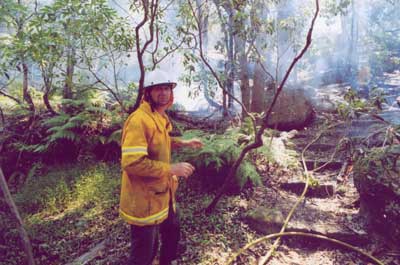
Restoration of The Buttress Reserve has been achieved through careful consultation and planning, hard work and financial contributions of adjoining residents working with Council’s bush regenerator, Pamela Batters – a lovely Yorkshire lass.

Over the past five years Pamela’s skill and sheer, hard physical work has transformed what was essentially a devastated, bamboo-infested wasteland into natural bushland complete with a dry, rock-lined creek that solves adjoining neighbours water run-off problems. Before planting was commenced all immediate neighbours were consulted extensively on the scale and form of flora so that views would not be impeded. Species were limited to those that would not exceed 6 metres and it was agreed that self-sown “mongrel” eucalypts would be removed if they threatened views and used for mulch.

Careful selection and placement of small trees and shrubs, generally no more than 2-3 metres in height, and their nurturing from tube stage by Pamela in a labour of love has created a place of natural beauty complemented by some quite remarkable rock formations. Her inspirational work has had other unforeseen spin-offs in the immediate community, enthusing adjoining neighbours to clear and plant their gardens empathetically with native flora.

Wanton destruction of her caring, considered work was devastating and almost destroyed Pamela’s motivation to continue, but I am pleased to report that she was back on the job in The Buttress Reserve this week, removing invading weeds and continuing her good work for the benefit of our community. We are indeed fortunate to have such a motivated person as Pamela working for us, and she deserves our support and vigilance in nurturing and protecting Castlecrag’s very special and unique bushland heritage.

John Steel